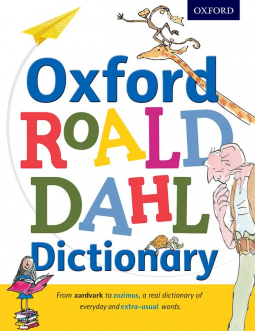
 Title: Oxford Roald Dahl Dictionary
Author: Susan Rennie
Pages: 288 Pages
Publisher: Oxford University Press
The Blurb
This is not an ordinary dictionary. After all, you wouldn’t expect an ‘Oxford Roald Dahl Dictionary‘ to be ordinary, would you? Lots of dictionaries tell you what an ‘alligator’ is, or how to spell ‘balloon’ but they won’t explain the difference between a ‘ringbeller’ and a ‘trogglehumper’, or say why witches need ‘gruntles’ eggs’ or suggest a word for the shape of a ‘Knid’.
All the words that Roald Dahl invented are here, like ‘biffsquiggled’ and ‘whizzpopping,’ to remind you what means what. You’ll also find out where words came from, rhyming words, synonyms and lots of alternative words for words that are overused.
Oxford Children’s Dictionaries are perfect for supporting literacy and learning and this is the world’s first Roald Dahl Dictionary from the word experts at Oxford University Press. With real citations from Roald Dahl’s children’s books and illustrations by Quentin Blake, the Oxford Roald Dahl Dictionary will inspire and encourage young writers and readers.
The Review
One of my earlier memories as a reader is of me sitting in my mum’s car (which was stationary on our driveway) and refusing to leave because I was reading a really good book. That book was Fantastic Mr Fox by Roald Dahl. The reason I mention this rather quirky reading location is because that memory has stuck with me and I think that great books can do that to you. If I have a memory of reading a book then I think it must have been good.
I loved Roald Dahl’s dastardly books. They were not your usual happy go lucky fairytales and when you reread them as an adult you can see that there are some pretty sinister things happening. I think that is what made Roald Dahl so successful. In a weird way he told the truth…not of witches turning children into mice (although just because I’ve never seen it happen doesn’t mean that it doesn’t happen) but by showing children that the world and the people are not always nice and sometimes people don’t always get their happily ever after. I think that is why – 25 years after Roald Dahl died – that his popularity has sustained.
The Oxford Roald Dahl Dictionary is the work of scholar Susan Rennie; she celebrates the work of Roald Dahl in this wonderful book which includes so much more than dictionary definitions. She explains literary techniques such as spoonerisms, malapropism and alliteration among many others. She also looks closely at certain characters and stories. It really is a wonderful reminder of all the fantastic stories: from Matilda to Esio Trot, Charlie and the Chocolate Factory to James and the Giant Peach. Rennie also included books of Dahl’s that I have to admit that I haven’t read (but they have swiftly been added on my to-be-read pile). On top of all of this, the Oxford Roald Dahl Dictionary includes the fabulous and instantly recognisable illustrations of the wonderful Quentin Blake.
Reading the Oxford Roald Dahl Dictionary is best described using one of Roald Dahl’s made up words – GLORIUMTIOUS! No children’s bookshelf is complete without it!
Oxford Roald Dahl Dictionary by Susan Rennie is available now.
For more information regarding Roald Dahl please visit www.roalddahl.com.
For more information regarding Oxford University Press please visit www.global.oup.com.
