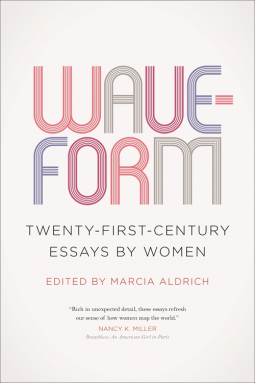
waveformTitle: Waveform – 21st Century Essays by Women

Author: Marcia Aldrich (Editor)

Pages: 256 Pages

Publisher: University of Georgia Press

The Blurb

Waveform: Twenty-First-Century Essays by Women celebrates the role of women essayists in contemporary literature. Historically, women have been instrumental in moving the essay to center stage, and Waveform continues this rich tradition, further expanding the dynamic genre’s boundaries and testing its edges. With thirty essays by thirty distinguished and diverse women writers, this carefully constructed anthology incorporates works ranging from the traditional to the experimental.

Waveform champions the diversity of women’s approaches to the structure of the essay—today a site of invention and innovation, with experiments in collage, fragments, segmentation, braids, triptychs, and diptychs. Focused on these explorations of form, Waveform is not wed to a fixed theme or even to women’s experiences per se. It is not driven by subject matter but highlights the writers’ interaction with all manner of subject and circumstance through style, voice, tone, and structure.

This anthology presents some of the women who are shaping the essay today, mapping an ever-changing landscape. It is designed to place essays recently written by women such as Roxane Gay, Cheryl Strayed, Margo Jefferson, Jaquira Diaz, and Eula Biss into the hands of those who have been waiting patiently for something they could equally claim as their own.

The Review

I like reading essays. I like that most essays I read give me access to a world that I usually have no concept of or have never experienced. This is why I chose to request Waveform from NetGalley. As expected, the essays featured in Waveform opened up doors to the writers minds and let me be privy to events that I didn’t previously have access too.

What I found was that some of the essays were so beyond my ken that I struggled to actively follow along whereas others had be turning the page so quickly so that I could absorb more. I realised that essays, like great novels can be read at any time but there are certain times when a great piece of writing finds you when you need it most. I think that is what is special about Waveform. It is that kind of collection.

Waveform by Marcia Aldrich is available now.

3-stars

ViewTitle: The View from the Cheap Seats: Selected Non-Fiction

Author: Neil Gaiman

Pages: 532 Pages

Publisher: Headline

The Blurb

The View from the Cheap Seats draws together myriad non-fiction writing by international phenomenon and Sunday Times bestselling author Neil Gaiman. From Make Good Art, the speech that went viral, to pieces on artists and legends including Terry Pratchett and Lou Reed, the collection offers a glimpse into the head and heart of one of the most acclaimed writers of our time.

‘Literature does not occur in a vacuum. It cannot be a monologue. It has to be a conversation’

Welcome to the conversation. Neil Gaiman fled the land of journalism to find truths through storytelling and sanctuary in not needing to get all the facts right. Of course, the real world continued to make up its own stories around him, and he has responded over the years with a wealth of ideas and introductions, dreams and speeches. Here ‘we can meet the writer full on’ (Stephen Fry) as he opens our minds to the people he admires and the things he believes might just mean something – and makes room for us to join the conversation too.

(Amazon Blurb)

The Review

I love Neil Gaiman. I have said that I would love to tickle his brain and hopefully some of that magic and talent could be captured by my fingers. Sadly, I don’t think that I am going to get the opportunity to tickle his brain so instead I will settle for reading his books.

I wanted to read The View from the Cheap Seats: Selected Non Fiction because I wanted to find out more about the man behind the writer. What was it that made Neil Gaiman so talented as a writer. It was the wrong thing for me to do. Neil Gaiman the man and Neil Gaiman the writer are one and the same. There is no line of distinction. What I did take from The View from the Cheap Seats: Selected Non Fiction is a deeper love for Neil Gaiman.

Truthfully, some of the essays in this selection did not have a massive impact on me. However, there were plenty that left me stunned. Personal highlights were:

On Stephen King, for the Sunday Times

2004 Harvey Awards Speech

Some Strangeness in the Proportion: The Exquisite Beauties of Edgar Allen Poe

Waiting for the Man: Lou Reed

The Dresden Dolls: Hallowe’en 2010

Eight Views of Mount Fuji: Beloved Demons and Anthony Martignetti

A Slip of the Keyboard: Terry Pratchett

All of these were fantastic reads. However, there were two essays that stood out for me. The first was Why Our Future Depends on Libraries, Reading and Daydreaming: The Reading Agency Lecture, 2013. I am a big advocate of libraries and the need for them in a community and so I sat reading this essay agreeing with every paragraph. Anyone who questions the need for libraries needs to read this essay.

The second essay that really had an impact on me was So Many Ways to Die in Syria Now: May 2014. It is heartbreaking. Truly.

Needless to say, my love for Neil Gaiman hasn’t wavered. The View from the Cheap Seats: Selected Non Fiction is a beautiful collection of essays and I fully recommend it.

The View from the Cheap Seats: Selected Non Fiction by Neil Gaiman is available now.

For more information regarding Neil Gaiman (@neilhimself) please visit www.neilgaiman.com.

For more information regarding Headline (@headlinepg) please visit www.headline.co.uk.

4 Stars

So Sad Today

The Blurb

From acclaimed poet and creator of the popular Twitter account @SoSadToday comes a darkly funny and brutally honest collection of essays.

Melissa Broder always struggled with anxiety. In the fall of 2012, she went through a harrowing cycle of panic attacks and dread that wouldn’t abate for months. So she began @SoSadToday, an anonymous Twitter feed that allowed her to express her darkest feelings, and which quickly gained a dedicated following.

In SO SAD TODAY, Broder delves deeper into the existential themes she explores on Twitter, grappling with sex, death, love low self-esteem, addiction, and the drama of waiting for the universe to text you back. With insights as sharp as her humor, Broder explores–in prose that is both ballsy and beautiful, aggressively colloquial and achingly poetic–questions most of us are afraid to even acknowledge, let alone answer, in order to discover what it really means to be a person in this modern world.

The Review

Oh it pains me to write this review because I really wanted to like So Sad Today. I honestly thought I would like it but I just didn’t.

So Sad Today chronicles writer Melissa Broder’s battle with depression and anxiety. Her struggles are broken down into manageable chunk sized chapters and they are written well; in particular, Help Me Not Be a Human Being. However – and this pains me to say – I found the writing self-indulgent and whiny. I hate writing this because I don’t want to take away from Broder’s struggle with depression and anxiety (nor do I want to add to her fragility) but other books have dealt with this subject in a more relatable way, such as Reasons to Stay Alive by Matt Haig. At times, it felt like Broder was trying to be deliberately provocative and taboo and it just didn’t seem realistic to me.

It is such a shame that I didn’t enjoy So Sad Today.

So Sad Today by Melissa Broder is available now.

2 Stars

It is not often, indeed I don’t think that it has ever happened, that a book has me choking back the tears and forcibly swallowing the lump that has formed in my throat back down. But then The Opposite of Loneliness is no ordinary book.

In its complete form the book is called The Opposite of Loneliness Essays and Stories. However, the author, Marina Keegan, cannot be held responsible for the onset of my emotional spiral. Marina Keegan is dead. The introduction was provided by her college professor at Yale from where Keegan graduated in 2012. Five days after she graduated she was killed in a car accident.

Entering this book I tried not to let the emotional impact of the writer’s death colour my opinion of the stories. It is too easy to do; glorify the poor girl who didn’t live to see her novel published. Fortunately, the beauty, truth and outstanding quality of Keegan’s writing meant that I wouldn’t have to worry about that; a fact that makes Keegan’s death all the more poignant.

The collection of short stories is simply breathtaking. The fact that someone so young, who hadn’t really lived, managed to find such an individual voice is beyond impressive. The stories are entertaining, sharp and beautifully written.

Keegan’s collection of essays covers a wide range of topics from the beaching of whales to the uncertainty of adulthood. Equally as impressive as her short stories her essays are filled with passion and fire, her words jump off the page and hit you with the sheer honesty of them. In the titular essay, The Opposite of Loneliness, the final essay that Keegan had produced for Yale Daily News, she told her fellow classmates that they were “so young”. She repeated the sentiment, trying to make her classmates realise that they had time to make or do things that they were passionate about. In her short time on this plain Keegan managed to leave her mark.

This book blew me away and I am genuinely saddened that the world of literature lost a promising writer before she truly had chance to shine.

The Opposite of Loneliness Essays and Stories by Marina Keegan is available now.